Fil:PIA17993-DetectorsForInfantUniverseStudies-20140317.jpg


Sammanfattning
| Beskrivning |
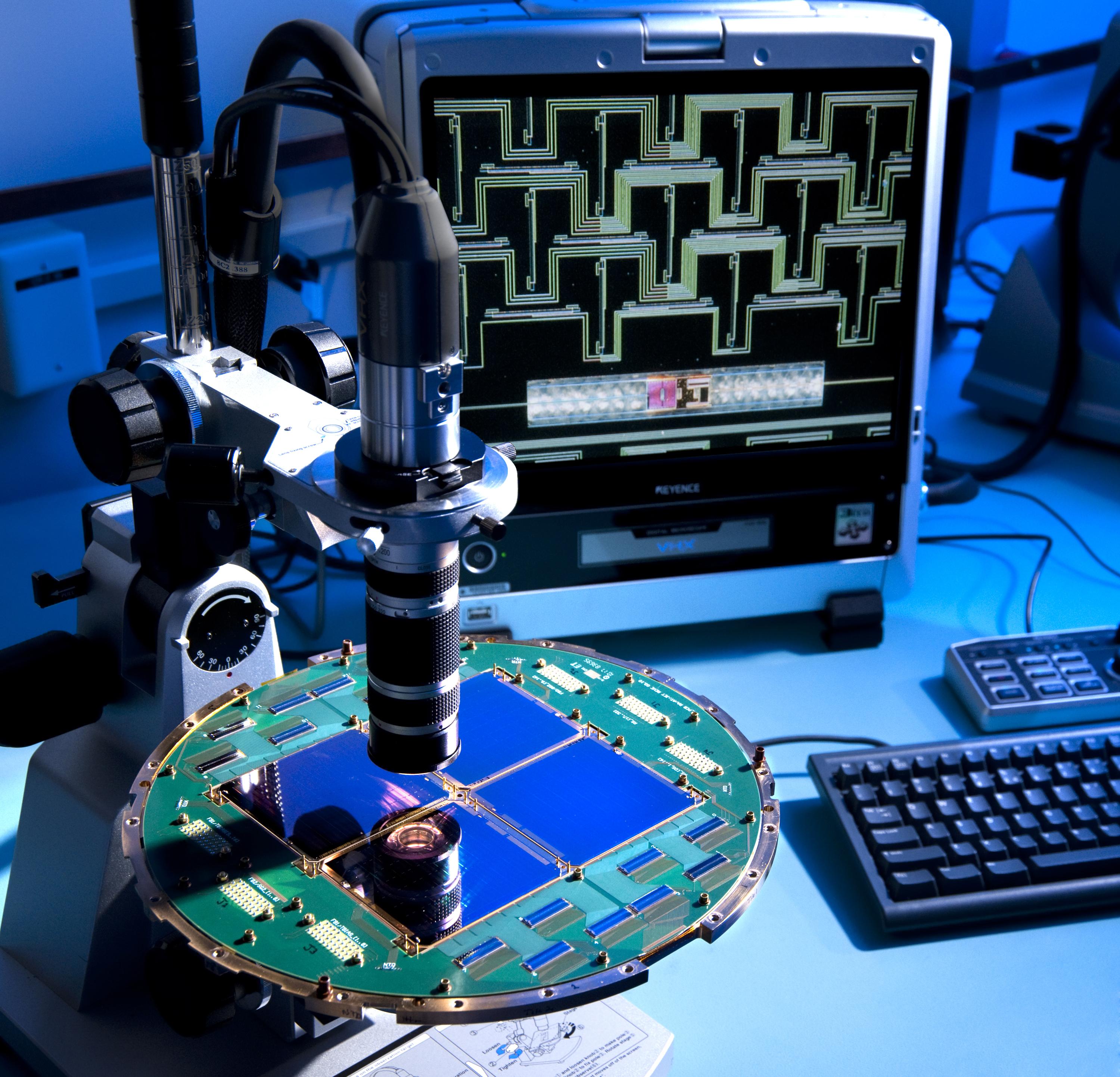
English: Superconducting Detectors for Study of Infant Universe
http://www.jpl.nasa.gov/spaceimages/details.php?id=PIA17993 http://www.jpl.nasa.gov/news/news.php?release=2014-082 The BICEP2 telescope at the South Pole uses novel technology developed at NASA's Jet Propulsion Laboratory in Pasadena, Calif. The focal plane shown here is an array of devices that use superconductivity to gather, filter, detect, and amplify polarized light from the cosmic microwave background -- relic radiation left over from the Big Bang that created our universe. The microscope is showing a close-up view of one of the 512 pixels on the focal plane, displayed on the screen in the background. Each pixel is made from a printed antenna that collects polarized millimeter-wavelength radiation, with a filter that selects the wavelengths to be detected. A sensitive detector is fabricated on a thin membrane created through a process called micro-machining. The antennas and filters on the focal plane are made from superconducting materials. An antenna is seen on the close-up shot in the background with the green meandering lines. The detector uses a superconducting film as a sensitive thermometer to detect the heat from millimeter-wave radiation that was collected by the antenna and dissipated at the detector. A detector is seen on the close-up shot in the background to the right of the pink square. Finally, a tiny electrical current from the sensor is measured with amplifiers on the focal plane called SQUIDs (Superconducting QUantum Interference Devices), developed at National Institute of Standards and Technology, Boulder, Colo. The amplifiers are the rectangular chips on the round focal plane. The focal planes are manufactured using optical lithography techniques, similar to those used in the industrial production of integrated circuits for computers. |
| Datum | |
| Källa | http://photojournal.jpl.nasa.gov/jpeg/PIA17993.jpg |
| Skapare | NASA/JPL-Caltech |
Licensiering

|
Upphovsrättsinnehavaren till denna fil, NASA/JPL-Caltech, tillåter vem som helst att använda den i valfritt syfte, förutsatt att lämplig hänvisning till upphovsrättsinnehavaren ges.
Vidaredistribution, redigering av verk, kommersiell användning och all övrig användning är tillåten. |
|
|
 
|
According to JPL's image use policy additional restriction is that no endorsement of any product or service by Caltech, JPL or NASA is claimed or implied.
Caltech's disclaimer: Caltech makes no representations or warranties with respect to ownership of copyrights in the images, and does not represent others who may claim to be authors or owners of copyright of any of the images, and makes no warranties as to the quality of the images. Caltech shall not be responsible for any loss or expenses resulting from the use of the images, and you release and hold Caltech harmless from all liability arising from such use. Usage on the English Wikipedia: On the English Wikipedia you can use the {{JPL Image}} template to display the copyright notice. (See w:Wikipedia:Using JPL images for details) |
Filhistorik
Klicka på ett datum/klockslag för att se filen som den såg ut då.
| Datum/Tid | Miniatyrbild | Dimensioner | Användare | Kommentar | |
|---|---|---|---|---|---|
| nuvarande | 17 mars 2014 kl. 22.13 | | 3 000 × 2 884 (842 kbyte) | wikimediacommons>Drbogdan | User created page with UploadWizard |
Filanvändning
Följande sida använder den här filen:
