Fil:Orbital elements.svg
Hoppa till navigering
Hoppa till sök

Storleken för denna PNG-förhandsvisning av denna SVG-fil: 748 × 599 pixlar. Andra upplösningar: 300 × 240 pixlar | 599 × 480 pixlar | 959 × 768 pixlar | 1 278 × 1 024 pixlar | 2 556 × 2 048 pixlar | 815 × 653 pixlar.



Originalfil (SVG-fil, standardstorlek: 815 × 653 pixlar, filstorlek: 15 kbyte)

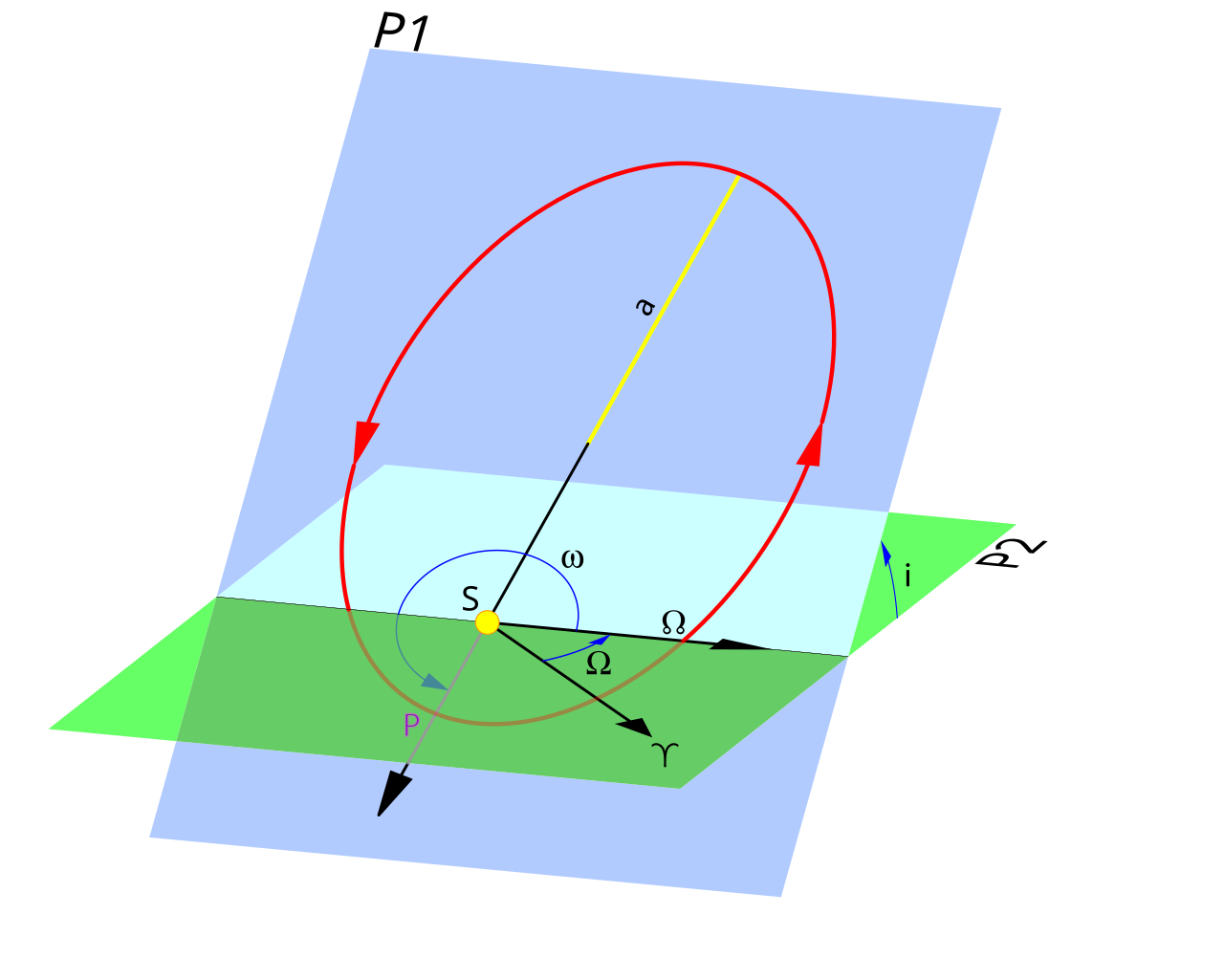
| P2 | Ecliptic plane |
|---|---|
| ♈ | Vernal point |
| S | Primary, e.g. Sun |
| P1 | Orbital plane |
| a | Semi-major axis |
| ☊ | Ascending node |
| Ω | Longitude of the ascending node |
| i | Inclination |
| P | Periapsis |
| ω | Argument of periapsis |
Sammanfattning
| Beskrivning | Schematics showing the orbital elements of an heliocentric orbit. |
| Datum | Modified 3. Mar. 2006. |
| Källa | This is a modified version of Bahnelemente.svg (GFDL) by ArtMechanic. The original version has been "internationalised", no sentences in any language are present. |
| Skapare | Brandir |
| Tillstånd (Återanvändning av denna fil) |
Brandir put it under the GFDL |
| Andra versioner | Image:Bahnelemente.svg |

Licensiering

|
Tillstånd ges att kopiera, distribuera och/eller modifiera detta dokument under villkoren i GNU Free Documentation License, Version 1.2 eller senare version publicerad av Free Software Foundation, utan oföränderliga avsnitt, framsidestexter eller baksidestexter. En kopia av licensen ingår i avsnittet GNU Free Documentation License. |
  
|
Denna fil har gjorts tillgänglig under licensen Creative Commons Erkännande-Dela Lika 3.0 Unported | |
| ||
| Detta licenstillägg lades till till denna fil som en del av GFDL:s licensuppdatering. |
Notes
- The longitude of periapsis is defined as the sum of the longitude of the ascending node and the argument of periapsis. It is a numerically convenient way of expressing the same quantity, but which does not have a direct geometrical meaning.
- The orbital focus S has been set here to the primary's position, which is the way orbits are defined in astronomy. It is also possible to express the orbital mechanics by setting S to the system's centre of mass (a barycentric orbit), in which case the semi-major axis will be smaller by a factor of up to 2.
Filhistorik
Klicka på ett datum/klockslag för att se filen som den såg ut då.
| Datum/Tid | Miniatyrbild | Dimensioner | Användare | Kommentar | |
|---|---|---|---|---|---|
| nuvarande | 3 mars 2006 kl. 23.59 | | 815 × 653 (15 kbyte) | wikimediacommons>Brandir~commonswiki | New version.Corrects a rendernig error of the SVG file |
Filanvändning
Följande sida använder den här filen:
